Manual notePage source detailsAI-generated or AI-assisted provenance details are available here.
Manual note details
This page source note preserves attribution details.
issue-388-how-to-use-placeholder-prose: Generated provisional reader-path guidance for issue 388 without changing route contracts or canonical reference pages.
Provider
openai
Model
gpt-5-codex
Prompt
Draft a short How to Use This Manual guide for EldritchDark. Explain how guide pages, reference pages, and the character creator relate. Do not duplicate mechanics or invent new publication policy.
issue-429-how-to-use-front-matter-rewrite: Rewrote the reader-path guide around first-time player and referee routes, live creator use, and the guide/reference distinction.
Provider
openai
Model
gpt-5-codex
Prompt
Rewrite the EldritchDark manual orientation page so it teaches how to read guides, references, and the creator before play.
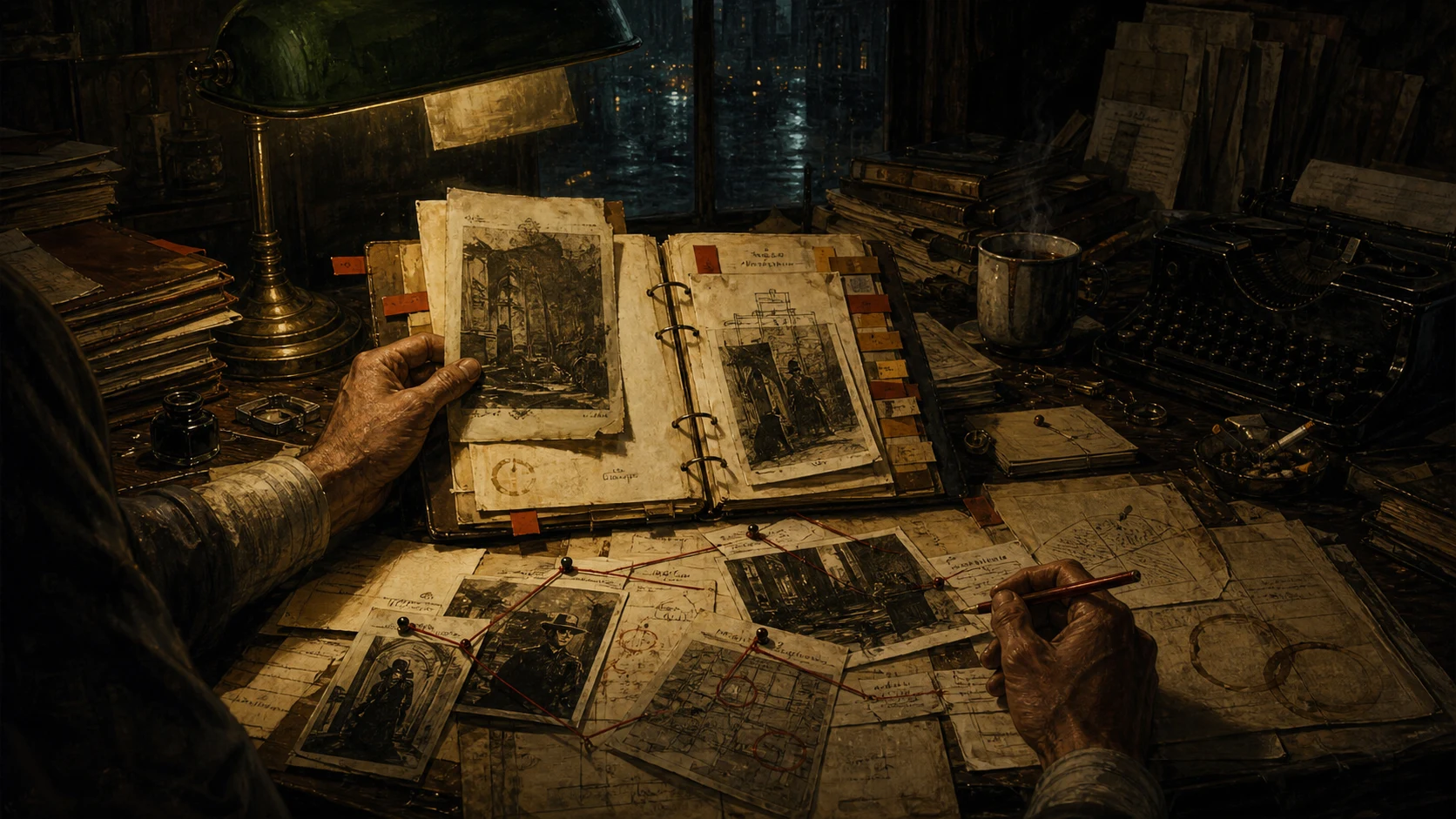
Use this manual like a case file. Start with the guide that matches your role, then keep the references close for the moment when a rule, table, item, spell, or record needs an exact answer.
The first route is simple. Players make a character, learn what their choices suggest, and bring intent and risk to the table. The referee frames the case, shows danger clearly, calls for rules when needed, and follows through on what the table chooses.
SourceProvenance detailsAI-generated or AI-assisted provenance details are available here.
Source details
This image source note preserves art attribution details.
issue-407-how-to-use-this-manual-section-opener: Accepted provisional production-quality section opener art for How to Use This Manual while preserving future human replacement history.
Provider
openai
Model
gpt-image-2
Prompt
Create one production-quality provisional section-opener illustration for the EldritchDark manual section "How to Use This Manual": a 1920s editor table and detective desk under a green-shaded lamp, open manual proofs, index cards, string, coffee rings, tabs, and a rainy window. Hands arrange case-file pages into a usable investigation path; at first glance it is a practical reading desk, on second viewing the page order casts an impossible shadow and one bookmark points where no chapter should exist. Use Weird Age pulp noir, cheap-paper color, ink black, sickly yellow lamplight, muted teal shadows, and one red pencil accent. Avoid readable text, labels, logos, watermarks, signatures, and schematic placeholder art.
Accepted asset path: /assets/eldritchdark/manual/placeholder-art/how-to-use-this-manual-section-opener.webp, Generated with the built-in Codex image generation workflow., Selected as one of the bounded issue 407 section opener targets., This event records curation and replacement intent only; issue 405 owns reader-facing section-page integration., Future human section opener art should supersede this AI event in the same log instead of deleting it.
SourceProvenance detailsAI-generated or AI-assisted provenance details are available here.
Source details
This image source note preserves art attribution details.
issue-408-how-to-use-this-manual-index-artifact: Accepted provisional production-quality spot or artifact art for How To Use This Manual Index Artifact while preserving future human replacement history.
Provider
openai
Model
gpt-image-2
Prompt
Create a compact manual navigation artifact with index cards, binder tabs, red string, dog-eared pages, a desk lamp edge, coffee rings, and a page order that casts an impossible shadow.
Accepted asset path: /assets/eldritchdark/manual/placeholder-art/how-to-use-this-manual-index-artifact.webp, Generated with the built-in Codex image generation workflow., Selected as one of the bounded issue 408 spot/artifact targets., This event records curation and replacement intent only; issue 409 owns reader-facing spot and artifact integration., Future human manual art should supersede this AI event in the same log instead of deleting it.
Three Kinds Of Help
Guide pages explain what a section is for and how to use it in play. Read them when you are learning the game, preparing a session, or deciding which reference matters.
Reference pages hold the lookup answers: jobs, bloodlines, gear, weapons, worship, baubles, and other table-facing records. Open them when the group needs a name, value, option, or exact entry.
The character creator is the live tool for a valid sheet. Use it before the first scene, then return to the guides when a choice needs meaning instead of validation.